Scrambling With Children: How Do You Know When They’re Ready?

Introducing your child to scrambling
For plenty of children, scrambling is where a mountain walk starts to become something different. Hands go onto rock. The path disappears. Instead of simply following a route, the family has to read the ground, choose a line and move through the mountain itself.
That can be hugely exciting. Scrambling is often the point where families begin to feel less like walkers and a little more like mountaineers. The children are no longer simply being taken up a hill: they are using balance, movement, judgement and problem-solving to find their own way through rocky terrain.
It opens up new kinds of days too. Rocky ridges. Cloughs and gullies. Hands-on routes to summits. Mountain journeys where the route itself becomes part of the adventure. And, done progressively, scrambling can give children an extraordinary sense of capability:
I can move through places that once looked impossible from below.
But it also changes the consequences of getting something wrong. A stumble on an ordinary path might mean muddy knees. A slip on exposed scrambling terrain can mean something very different.
So when is a child ready? There isn’t a single answer such as eight, ten or twelve. And there isn’t a scrambling grade that provides one either.
The question we think parents should ask is:
Is this child ready for this scramble, with these adults, in these conditions, today?
That is a much more useful place to start.
Readiness isn’t one thing
At Adventure Baggers, we believe there are four parts to the readiness judgement. All four act together, and it’s the combination of things being right across all four that means it’s time to try the exciting world of scrambling.
The Child
The Route
The Conditions
The Adult(s)
Change any one of those and the answer may change with it. A capable child on familiar rock in dry, calm weather with two experienced adults is one proposition. The same child on unfamiliar exposed terrain, in strengthening wind, with one adult also responsible for two younger siblings is another.
That is why lists of “scrambles suitable for children” can only ever take you so far.
Family suitability isn’t simply a characteristic of the route. It is a relationship between the route, the conditions and the people attempting it.
1. Start with the child
Age matters. But largely because it affects other things that matter more: movement; attention; judgement; stamina; reach; and the ability to understand what is happening and respond appropriately.
Two children of exactly the same age may therefore be ready for completely different terrain.
How well do they actually move?
Before deliberately introducing exposure, watch how your child moves somewhere where mistakes have relatively small consequences.
Can they choose secure footholds rather than simply haul themselves upwards? Can they use hands and feet together? Maintain balance on uneven rock? Stop and think when a move isn’t obvious? Try another line rather than forcing the first one?
And importantly: can they climb down? Getting upwards is often exciting and instinctive. Down-climbing tends to demand more control, patience and awareness of where the feet are going.
Watch what happens when they’re tired too. A child who moves beautifully across rock at the beginning of the day may look very different after several hours on the hill.
There is enormous value in spending time on boulders, rocky stream beds and non-committing scrambling terrain before introducing significant exposure. It is always worth building movement skills on forgiving ground first.
What happens when they feel exposed?
Physical competence isn’t the whole story.
Children respond very differently to exposure. Some become cautious. Some freeze. Some become excited. And some appear completely fearless.

That last response isn’t necessarily the one you’re looking for. A child doesn’t need to feel completely comfortable with heights before scrambling. Learning to manage nerves can be part of the experience.
But you need to know what happens when nervousness appears. Can they stop? Listen? Explain how they are feeling? Concentrate on the next movement? Or does anxiety make their movement and communication deteriorate?
At the other extreme, does a very confident child understand that confidence doesn’t change consequence? A cautious child making thoughtful decisions can be much better prepared for exposed terrain than an enthusiastic child who launches at everything.
The objective isn’t to make children fearless. It’s to help them develop judgement.
Can they follow an instruction when it matters?
On an ordinary walk, ignoring “wait there” may be irritating. On scrambling terrain, it can matter. There will be occasions when a child needs to understand instructions such as:
Wait until I’m in position.
One person at a time.
Use this line rather than that one.
Don’t go beyond that point.
We’re turning back.
That doesn’t mean scrambling should become an hour of adults issuing commands. As capability grows, children should increasingly make decisions for themselves. But on consequential terrain, the adult still needs to be able to intervene.
Agency grows with capability. Responsibility for safety remains with the adult.
2. Look beyond the grade to understand the scrambling route
UK scrambles are generally graded from 1 to 3. Grade 1 sits at the easier end. Higher grades introduce increasingly technical climbing, exposure and greater likelihood that proper ropework will be required. Useful information. But there is an important trap:
Grade 1 does not mean “suitable for children”. It doesn’t even mean that two Grade 1 routes represent remotely similar family decisions.
Consider some of the classics.
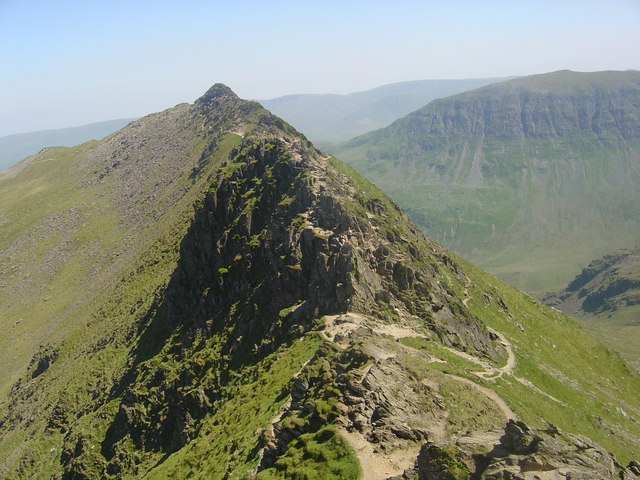
Striding Edge
Grade 1.
There is real exposure, but in dry and calm conditions much of the ridge allows a choice between the crest and a bypass path just below it. There is, however, a section where the crest becomes unavoidable, including the steep climb up to the summit of Helvellyn. But this is a classic early scramble for beginners.
Crib Goch
Also Grade 1.
But now you have sustained exposure, greater commitment and much less opportunity simply to decide halfway across that you’ve had enough. Despite its grading, this one is definitely not an option that should be considered for a first scramble.
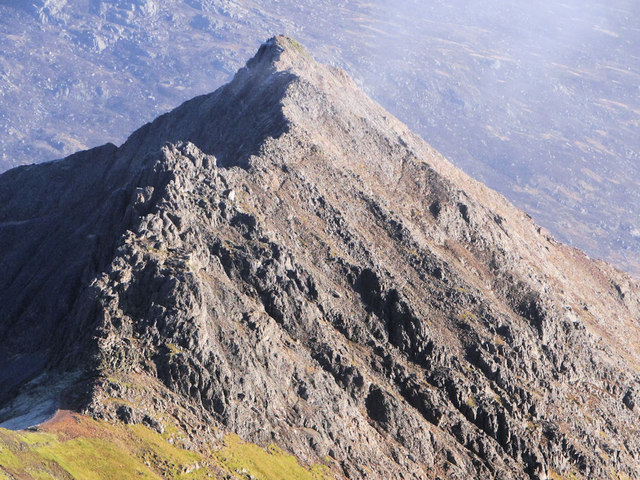
Sharp Edge
Grade 1 again.
But it is considerably more awkward and exposed than many introductory scrambles. Wet conditions make the rock particularly problematic, and it is not a route to treat casually because of the number attached to it.
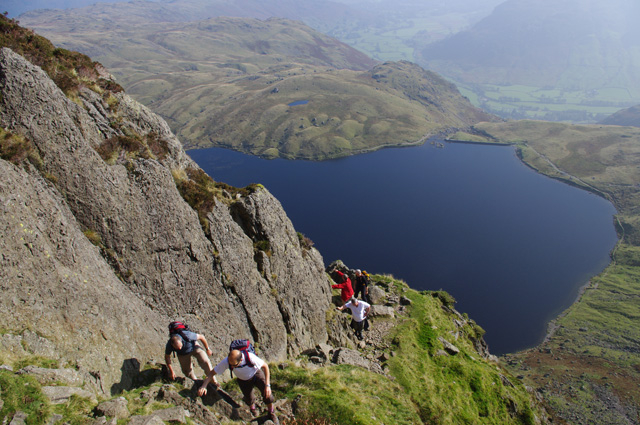
Jack’s Rake
Still Grade 1.
Yet it crosses the face of Pavey Ark, contains meaningful exposure and is harder to escape once committed. Same headline grade. Very different proposition.
The grade should therefore be treated as one piece of information when assessing the suitability of a route, but it should never be assumed that a low grade means the route is suitable for children or beginners.
So, what actually makes a good family scramble?
Instead of asking only about grade, look at the character of the route.
Technical difficulty
How hard are the actual movements? Are there awkward steps that a shorter child may struggle to reach?
A move that feels trivial to a six-foot adult can be an entirely different physical problem for a small child.
Exposure
How much time is spent somewhere where a slip could have serious consequences?
Is exposure brief? Avoidable? Or sustained?
Consequence
This is not quite the same as difficulty.
A technically easy step above a large drop can demand much more judgement than a physically awkward climb a metre above safe ground.
Commitment
How easy is it to change your mind? Can you walk away from the scramble? Can you easily retreat?
Or does beginning the route commit you to progressively more serious terrain?
For early family scrambling, options are valuable.
Length
A child enjoying twenty minutes of rock tells you very little about how they will cope with two hours of sustained concentration.
And consider the whole day, not just the scrambling section.
There may still be a long approach, summit and descent.
Escape Routes
If somebody isn’t enjoying themselves, can you stop?
If the weather changes, is there a straightforward alternative?
If somebody becomes exhausted, do you still need to complete the hardest part?
Route-finding
Is the easiest line obvious? Or could wandering a short distance from it put the family onto substantially harder ground?
Together, those questions often tell you far more about family suitability than Grade 1.
Before choosing a scramble, look at several route-specific sources rather than relying on the grade alone. Google extensively, but as a general guide, platforms such as Komoot, AllTrails, OS Maps and Walkhighlands can help you understand the route shape, distance, ascent, terrain and user experience, while photos and recent trip reports can give you a much better feel for what the scrambling sections actually look like.
3. Conditions can change the scramble completely
The guidebook describes the route. It cannot describe the route today.
Wet rock reduces friction. Wind affects balance. Cold reduces dexterity. Low cloud can make navigation harder. Ice can transform summer scrambling into mountaineering terrain.
Crowds can matter too. Narrow routes feel different when people are queuing, overtaking or moving above you.
This gives families a simple principle:
Don’t decide whether you’re doing the scramble when you book the weekend. Decide when you meet the conditions.
Have another route. Know where the alternatives are. Be willing to use Plan B.
That isn’t losing the adventure. That’s mountain judgement.
4. Ask whether the adults are ready too
The question of whether the child is ready can become so dominant that we forget to ask the equally important questions about the adult(s). They need to be ready as well.
Do you have the skills?
Can you comfortably move across the terrain yourself? Crucially, can you do that while supervising and – where needed – assisting someone else? Do you know the route? Can you recognise if you’ve wandered onto harder ground? Do you know the descent? Could you manage a child who suddenly becomes frightened and refuses to move? What would you do if somebody became injured?
And, if you believe the route may require rope protection, can you actually provide that protection competently? A rope isn’t a magic safety device. Once proper protection is needed, selecting anchors, belaying, protecting movement and managing the group require technical skills. At the higher scrambling grades, scrambling increasingly overlaps with climbing and mountaineering.
Are you sufficiently confident using those skills?
It is one thing to move comfortably across scrambling terrain on your own.
It is another to do that while watching a child, talking them through a move, deciding where to position yourself, managing your own exposure and still thinking clearly about the wider route.
If the terrain makes you sufficiently nervous that your own movement becomes hesitant, your attention narrows or you are no longer confident in your decisions, your ability to support the child changes too.
That does not mean adults should never feel apprehensive. Some nerves are normal. But the adult needs enough spare capacity to remain calm, communicate clearly and apply their skills while somebody else is relying on them.
A useful question is:
Am I comfortable enough on this terrain to manage myself and still have attention left to manage my child?
If the answer is no, the route may be within your personal climbing ability but beyond your current capability as the responsible adult in a family group.
One adult changes the equation
If there is only one capable adult, include that in the calculation. With two adults, one can position above a difficult step while another remains below. One can concentrate on a child who is struggling while the other manages siblings. One can deal with an injury while the other looks after the rest of the group.
With one adult, all of those roles sit with one person. That does not mean lone-adult families shouldn’t scramble. But adult-to-child ratio is part of the risk assessment, particularly as consequences increase.
And there is another question:
What happens to the children if I am the person who gets injured?
That links directly to the family’s wider Help Horizon — the time you may need to manage a problem yourselves before effective help reaches you. The longer the Help Horizon, and the more consequential the terrain, the more capability and contingency the family needs.
Professional support opens doors
A well-led scrambling day can allow a family to experience more technical terrain while learning movement, route choice and mountain judgement properly. Using a professional at the right time helps to ensure that you build your skills so that your family can scramble safely and independently.
Start somewhere mistakes are cheap
A child’s first scrambling experiences do not need to have names.
Look for places where they can practice using hands and feet together; choosing footholds; testing different lines; down-climbing; moving one at a time; waiting for somebody ahead; and saying that something doesn’t feel right.

But initially choose places where getting one of those decisions wrong has small consequences. Boulders. Rocky stream beds. Short rock steps beside a path. Low-level rocky routes with straightforward escape.
Give them the physical vocabulary of scrambling before adding serious exposure. Then increase the demands gradually. More sustained rock. A longer day. Some route choice. A little exposure. A mountain scramble.
There is no prize for skipping stages.
Some candidates for a first proper family scramble
Once children move confidently on easier rocky ground, you may want something that feels like a real mountain scramble without jumping immediately to Britain’s famous exposed ridges.
No route becomes automatically suitable because it appears in this list. You still need to apply everything above to your child, your group and the conditions on the day. But these routes have characteristics that can make them useful progression options.
Crowden Clough – Kinder Scout, Peak District
Good for: movement, problem-solving and a first scramble within a larger mountain walk
Crowden Clough is a particularly good example of why the Peak District can be excellent family scrambling territory.
From Edale, the route follows the stream towards Kinder Scout.
Before the scrambling becomes significant, there are opportunities to hop between boulders, cross rocky sections and let children experiment with different lines.
That gives adults time to watch how the child is moving before the terrain becomes steeper. And, if you do need to back off the steeper sections, the family has still got a flavour of scrambling.

Higher up, the clough provides more obvious hands-on scrambling around the waterfall before emerging onto the Kinder plateau. The scrambling is relatively short-lived, but the day still has the satisfying shape of a proper mountain ascent.
We think this one’s an ideal starting point for many families.
Grindsbrook Clough – Kinder Scout, Peak District
Good for: a first full mountain day where scrambling becomes part of the route

Grindsbrook offers another strong introduction from Edale.
The route begins as a normal walk alongside Grinds Brook.
As you climb towards Kinder, the ground becomes progressively rockier until the final ascent of the clough brings more definite scrambling before emerging onto the plateau.
This is a great starting point for scrambling in the Peak District, and can be readily incorporated into an 8 mile circular walk from Edale.
Its attraction for a family is partly what it doesn’t involve. There isn’t a sustained knife-edge ridge. Exposure isn’t the defining feature of the day.
Instead, children experience the sense of using their hands to find a way onto the plateau, within the context of a bigger hill walk.
As with all stream and clough routes, however, wet weather and high water can significantly change what you encounter.
Stickle Ghyll, Langdale – Lake District
Good for: lots of hands-on movement with plenty of opportunities to opt out
Stickle Ghyll is another interesting progression route because the adventure can begin almost immediately.
The rocky watercourse climbs from near the valley floor towards Stickle Tarn. Much of it offers choices. Scramble directly up rocky sections. Pick a gentler line. Or leave the ghyll and use the path nearby.

One substantial waterfall can be bypassed, and the proximity of the walking path means there are frequent opportunities to change the plan. Escaping the route is easy, making it well suited to scrambling with children.
The water itself adds another dimension. Expect wet rock. Expect wet feet. Quite possibly expect a child who has somehow managed to become wet considerably further up their body than appeared physically possible. Spare clothing is useful.
What we would not suggest is automatically continuing from Stickle Tarn onto Jack’s Rake simply because everybody enjoyed the ghyll. The character and consequences change substantially. That is another adventure for another stage.
Y Gribin, Eryri
Good for: families ready to progress from cloughs towards more consequential mountain terrain
Y Gribin offers a different experience.
Instead of following a stream, you begin to encounter the shape of a genuine mountain ridge.
The approach allows children to get onto easier rock first, with opportunities to assess how everybody is moving before the ridge becomes narrower higher up.
There are useful escape possibilities during the earlier part of the route, before the character becomes more committed. That makes it potentially valuable as a progression route rather than a first-ever scrambling experience.
It also moves the family into a more serious mountain environment. Navigation, weather and the adult’s own scrambling competence become increasingly important. By this stage, you want to know rather than hope that your child enjoys moving on rock.
Striding Edge – Helvellyn, Lake District
Good for: introducing genuine mountain exposure after children already have scrambling experience
Striding Edge is famous for good reason.
And for the right family, in good conditions, it can be a logical next step.
But we’d think of it as a potential first exposed ridge, not a child’s first encounter with scrambling.
For much of the route, walkers can choose between the crest and paths slightly below it, allowing some control over the amount of exposure experienced. It should be noted the even the bypass path has more challenging sections of loose scree and areas where it peters out and it’s necessary to rejoin the ridge. And there is eventually a section where the ridge itself becomes unavoidable, including the climb up to the summit of Helvellyn.
That makes the progression important. First establish that the child can move competently on rock. Then learn how they respond when consequences become more visible. Then consider an exposed ridge. Dry rock, low wind and good visibility matter enormously.
Don’t rush for the classics
This may be more important than the list itself.
The scramble everyone has heard of isn’t necessarily the one that teaches your child the most.
Crib Goch brings sustained exposure and significant commitment.
Sharp Edge is awkward and serious for Grade 1, particularly when wet.
Jack’s Rake adds exposure and more difficult retreat.
Tryfan’s North Ridge introduces substantial route-finding complexity, with opportunities to stray onto harder terrain.
There is nothing gained by making the famous ridge your child’s introduction to scrambling. A day in a Peak District clough where they learn to choose footholds, solve little movement problems and make good decisions may develop far more useful capability.
Choose the route that develops the child – not the route that gives the adult the best photograph.
Let the child have a real voice

Before taking on consequential terrain, tell children what is coming.
Not: “you’ll be fine”. But: “there’s an exposed section ahead where the ground falls away. How are you feeling about that?”
Show them photographs beforehand. Explain the harder part. Talk about where you can change the plan.
And make sure that “I don’t want to do this” is genuinely available as an answer. That doesn’t mean every wobble ends the day. A child can be nervous and still decide they want to continue. A calm adult can help break an intimidating section into manageable steps. But there is an important difference between helping a child through fear they want to overcome and pushing them through something they no longer want to do.
Listen. Observe. And remember that child voice works in both directions. A child may desperately want to continue when the adult judges that conditions or consequences make that a bad decision.
Every family member gets a voice. Adults retain responsibility for safety.
Praise judgement, not just bravery
After a successful scramble, it is easy to say:
You were so brave.
Sometimes that’s true. But notice the other achievements too.
You stopped and thought about that move.
You told me when you weren’t comfortable.
You waited until the person ahead was clear.
You chose the easier line.
You changed your mind when the conditions weren’t right.
These are not lesser successes. They are evidence of something far more useful than fearlessness.
Judgement.
If children learn that the only celebrated outcome is pushing through and reaching the top, they may learn to suppress uncertainty. If careful choices, communication and turning around are valued too, the lesson is different.
Making a good decision counts.
Know what would make you turn back
Don’t wait until everybody is struggling to invent the threshold. Before starting, think about what might change the decision. The rock is wetter than expected. The wind is stronger. A child is already tired on the approach. Somebody freezes when the exposure appears. Movement becomes less controlled. The route is taking much longer than expected. You can’t confidently identify the intended line. Crowding makes a narrow section uncomfortable. The adult no longer feels able to manage the group safely.
Turning around early is normally much easier than turning around once everybody is committed. And pay attention to deteriorating movement. Tired children stumble more. Adults do too. If somebody who was moving confidently begins rushing, slipping or repeatedly requiring physical assistance, something important has changed.
The mountain may be exactly the same.
The family’s capability on it isn’t.
So when is a child ready for scrambling?
Not at a particular birthday. Not because they have climbed a big mountain before. And not because the guidebook says Grade 1.
A child may be ready when their movement, concentration, communication and judgement are appropriate for the particular terrain you are considering.
The route needs an appropriate combination of difficulty, exposure, consequence and commitment.
The conditions need to keep that terrain within the family’s capability.
And the adults need sufficient skill and capacity to manage the group.
So instead of asking:
Is my child ready for scrambling?
Ask four questions.
Is the child ready for this terrain?
Movement, judgement, communication, stamina and response to exposure.
Is this the right route?
Difficulty, consequence, commitment, length, route-finding and escape options.
Are the conditions right today?
Weather, rock, visibility, crowds and daylight.
Are we the right team for it?
Adult capability, supervision, group size, equipment, contingency and Help Horizon.
When all four line up, scrambling can be a brilliant next stage in a family’s mountain adventures. When they don’t, choose something else. There will always be another route. Another day. Another year.
The goal isn’t to get children onto the most impressive ridge as early as possible. It’s to help them gradually become the kind of people who can stand in the mountains, understand what is in front of them, make good judgements about it – and trust that their voice will be heard.