Hiking With A Child Carrier: Helping Little Legs Go Further

Hiking with a child carrier can unlock bigger adventures while keeping your child at the heart of the experience
One of the quiet fears of becoming a parent is that adventure might have to stop for a while.
The mountain paths, woodland trails and long days outdoors can suddenly feel out of reach. A buggy will only take you so far, while little legs are not yet ready to carry a child through an entire day.
A child carrier changes that story.
It can take a baby into the woods, help a toddler reach their first mountain viewpoint and allow a family to explore places that would otherwise have to wait. It does not make every route suitable, and it does not remove the need for good judgement. But used well, it can be one of the most liberating pieces of family outdoor equipment you own.
The important thing is to understand what the carrier is really for.
The Adventure Baggers Principle
A child in a carrier is not being taken along for an adventure. They’re a core part of it.
The carrier changes the range, not their role
It is easy to think of a carrier as a way to transport a child from the car park to an adult objective. But the best carrier days rarely work like that.
Children are not cargo. They are participants in the adventure, whether they are walking beside you or sitting high on your back.
The carrier gives little legs a much bigger range. It allows you to make progress along the sections that would otherwise use all their energy, then lets them come out to explore the parts that matter most: the stream crossing, the woodland, the rocks beside the path, the waterfall or the summit shelter.
Carry when carrying adds to the adventure. Walk when walking adds to the adventure.
That might mean carrying a toddler along a broad forest track, then letting them scramble around a safe clearing. It might mean walking together beside a lake before using the carrier for the climb home. Or it might mean bringing the carrier as reassurance, only to discover that your child wants to walk much more than you expected.
Getting in and out is not an inconvenience that interrupts the hike. For young children, it is often the rhythm that makes the adventure possible.
Let little legs do some of the work
Toddlers learn about the outdoors with their whole bodies. They want to touch bark, step in mud, balance on logs, throw stones into water and stop to study things adults would walk straight past.
Those moments may not help you cover miles, but they are where a child’s relationship with adventure is built.
Plan time for slow walking and exploration. Choose places where your child can safely get out of the carrier. Expect progress to come in bursts rather than at an even adult pace. Bring far more snacks than seems reasonable.
The carrier then becomes support rather than restraint. It is there when enthusiasm outruns stamina, when a nap is needed, when the path becomes unsuitable for small feet or when everyone needs to make easier progress towards home.
This approach also helps children feel ownership of the day. They are not simply being delivered to a viewpoint. They have walked, explored, chosen, noticed and contributed.
Make the adventure vivid from the carrier
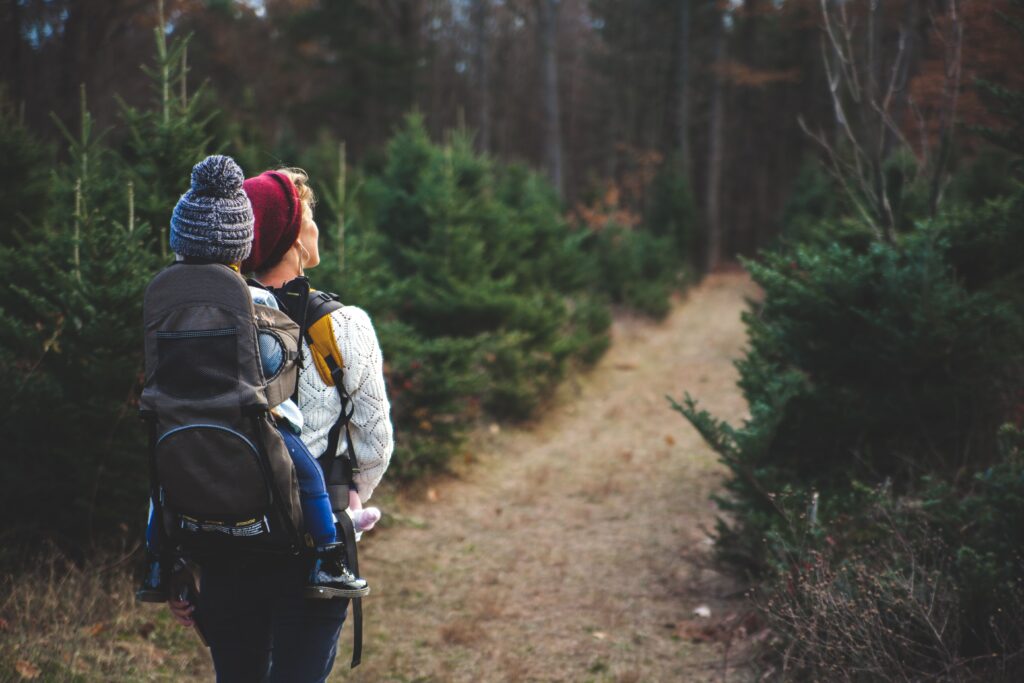
A child in a carrier has one of the best seats in the landscape. They can see over walls and hedges, watch birds above the trees and look ahead along the path.
Keep them connected to what is happening. Talk about where you are going. Point out the changing shape of the hills. Listen for streams, birds and animals. Tell them when the wind is becoming stronger or when you are stopping to check the map.
Ask simple questions: Can you see the waterfall? Which path do you think we take? Can you hear the river? How many sheep can you count? What colour are the clouds?
For babies, narration and shared attention are enough. For toddlers, games and small choices can transform the ride. Let them choose the snack stop, carry a soft toy, look for a particular colour or announce the next landmark.
Check in regularly, even when they seem content. A quiet child may be absorbed in the view, but they may also be cold, uncomfortable or tired. Conversation helps you remain connected to both their experience and their wellbeing.
Choose routes that open possibilities safely
A carrier expands the family’s options, but it does not make every adult route appropriate.
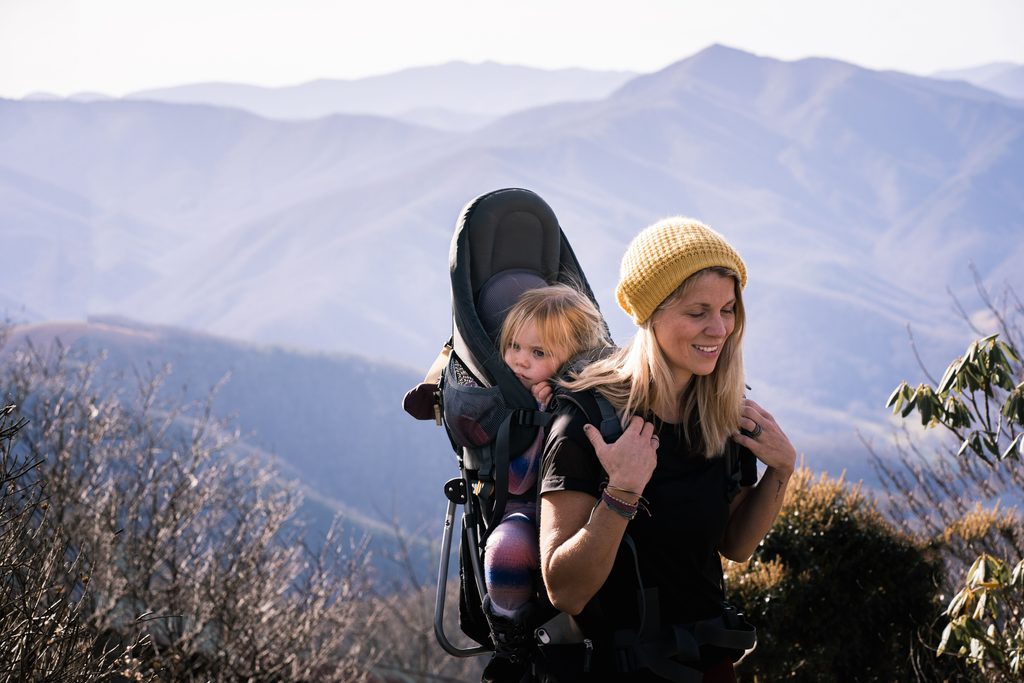
A framed carrier places a heavy, moving load above and behind your natural centre of gravity. Your balance changes. Descents feel different. Turning, stepping over obstacles and recovering from a stumble all become harder. A child may lean suddenly, reach for a branch, bounce with excitement or fall asleep and slump to one side.
The right route is therefore not simply one you could manage without the carrier. It is one that remains comfortably within your control while wearing it.
Look for reliable paths, moderate gradients, limited exposure, safe stopping places and easy ways to shorten the day. Think carefully about stiles, narrow gates, low branches, slippery stepping stones, loose ground and rocky descents. A broad hill path, woodland trail or lakeside route can deliver a far better family adventure than a more dramatic objective reached through awkward terrain.
The carrier should unlock wonderful places, not reduce your margin for error until the day becomes stressful.
Learn how the load changes the way you move
Practice before the first big day. Learn every buckle and adjustment. Walk locally with the carrier fitted, then build up gradually in distance, ascent and terrain.
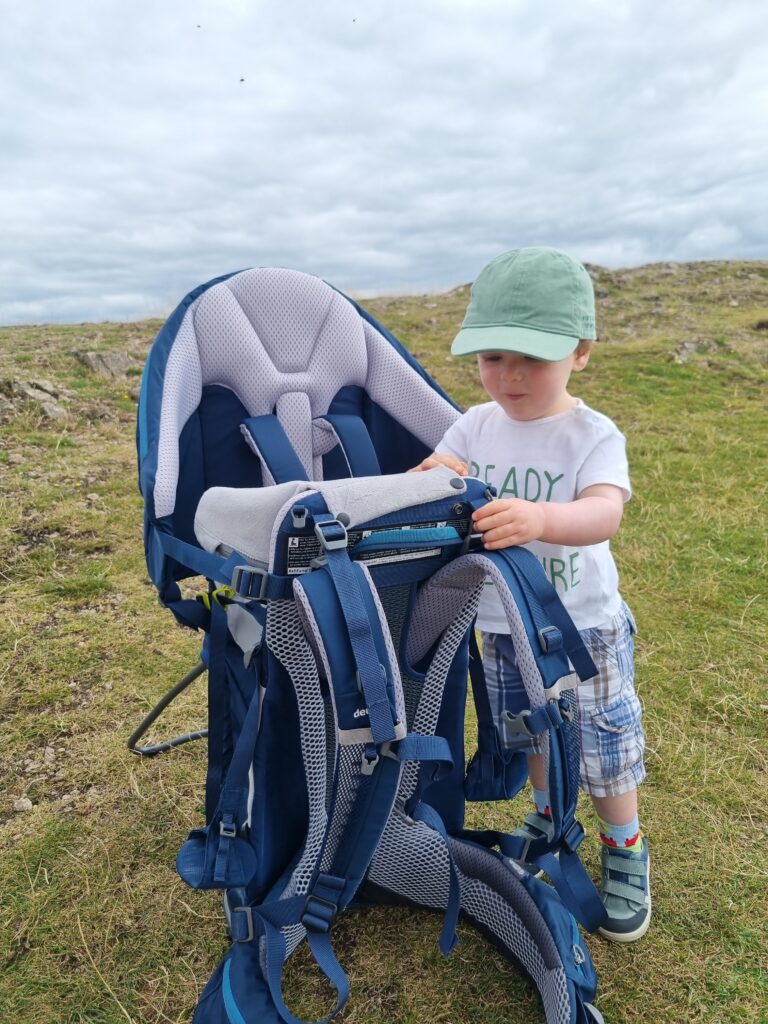
The carrier should sit close to your body, with most of the weight supported through the hip belt rather than hanging from the shoulders. Recheck the fit after the first few minutes, because clothing and straps can settle.
When walking, take shorter, deliberate steps and slow down on descents. Turn your whole body instead of twisting. Allow extra clearance above and behind you: the adult may pass beneath a branch that strikes the child.
Strong winds deserve particular respect. A carrier creates a larger surface for gusts to act upon, while sunshades and weather covers can catch the wind. Conditions that feel calm at the car may be very different on an open hillside.
Genuine scrambling, exposed ridges and terrain where a slip could have serious consequences are not natural extensions of carrier walking. The carrier raises the centre of gravity, restricts movement and prevents the child from protecting themselves. Save those adventures for another stage of the family’s journey.
Load, unload and pause with care
Some of the most awkward moments happen while putting the carrier on or taking it off.
Use level, stable ground. Where possible, have another adult steady the carrier while the carrying adult puts it on. When alone, practise the manufacturer’s exact technique without the child first.
The support stand is there to help with loading. It does not turn an occupied carrier into a freestanding child seat. Never leave a child unattended in it or place it on a bench, table, wall, steep slope or near an edge.
During breaks, take the child out. That gives them the movement they need and gives you a chance to check the harness, straps, clothing, temperature and comfort.
Plan for the whole family day
Carrier adventures need more time than an equivalent adult walk. There will be snack stops, nappy changes, clothing adjustments, investigations, walking bursts and moments when the child has very firm views about the plan.
Build that into the day rather than treating it as delay.
Carry the normal equipment for the route and conditions, alongside food, drink, spare clothing, changing supplies and suitable weather protection for the child. Remember that the carrier’s maximum load may include the child and everything stored in it. Check the manufacturer’s limits rather than assuming that a child who still fits can still be safely carried.
Inspect the carrier before each outing. Check the frame, fabric, stitching, harness, buckles, straps, seat, footrests and stand. Stop using it if anything appears damaged or unreliable.
Know when to change the plan
Turning around, shortening the route or choosing the lower path is not a failed adventure.
Change the plan if the carrier feels unstable, the adult is becoming tired, the child is distressed or uncomfortable, the weather deteriorates, the wind begins to affect balance or the terrain is harder than expected.
Explain the decision in simple terms. Children can learn that good adventurers notice what is changing and respond. The lesson is not that the mountain defeated the family. It is that the family made a wise choice and protected the possibility of another adventure.
One day the carrier will come home empty
At first, the carrier may do almost all the work.
Then your child begins walking the flatter sections. Later, they manage the woodland trail, the climb to the viewpoint or the final stretch to the waterfall. Eventually there will be a day when you bring the carrier and never use it.
The walk may only be three miles. It may take far longer than an adult would expect. There may be an astonishing number of snacks, long pauses to throw stones into water and almost as much exploring as hiking.
But somewhere along the way, your child will realise they have done the whole thing themselves.
The smile on their face will tell you that the miles were never the point.
The carrier has done its job. It was never meant to carry them forever. It was a bridge: from being taken into wild places to moving through them under their own power.
And because those places already feel familiar, joyful and shared, they will not be starting from nothing. They will already know that they belong there.
Your next carrier adventure
Choose somewhere with one memorable feature: a waterfall, lake, woodland, viewpoint or stream. Plan a route that gives you time rather than pressure.
Let the carrier help with the distance, but leave space for your child to walk, explore and shape the day. Talk to them while they ride. Stop before they become cold or uncomfortable. Change the plan when the conditions or the family need you to.
The measure of success is not how far the adult carried the child.
It is whether the carrier helped the family reach a place, share an experience and come home wanting to do it again.
Before you set off
- The child meets the carrier manufacturer’s developmental and weight requirements.
- The carrier is undamaged, correctly adjusted and within its total load limit.
- The adult can comfortably control the full load over the planned terrain.
- The route avoids genuine scrambling, serious exposure and awkward obstacles.
- The weather, wind, temperature and daylight provide a comfortable safety margin.
- There are safe places for the child to get out, move and explore.
- The plan allows time for slow walking, snacks, stops and changes of mind.