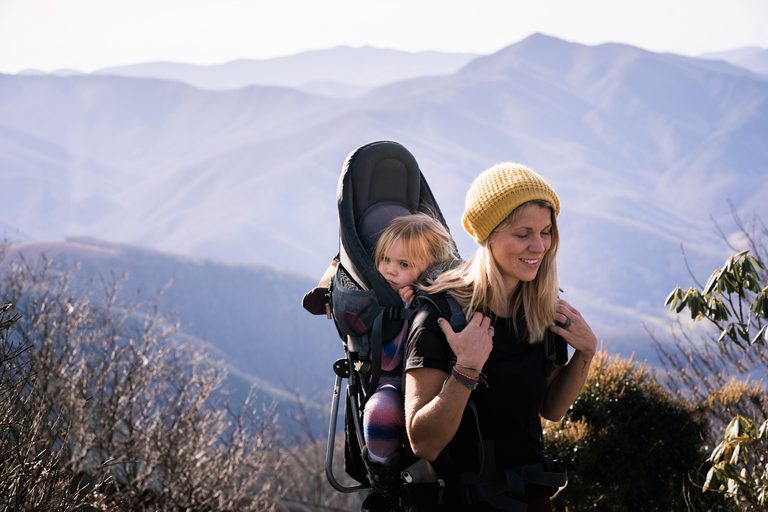
Which Is The Best Child Carrier For Hiking? A Family Guide

The best child carrier for hiking is not the one with the longest feature list. It’s the one that helps your family say yes to more of the right adventures
A good carrier can change the shape of family life outdoors.
It can take you beyond the buggy-friendly path. It can help tired legs reach the waterfall, keep a family walk going when a toddler has simply had enough, and open up places that might otherwise feel out of reach for a few years.
That makes choosing one look like a technical buying decision. You will see weight limits, litres of storage, ventilation systems, suspension designs and accessory lists.
All of those things matter. But they only matter because of what they make possible. So that’s where we at Adventure Baggers start – not with the spec list, but with the kinds of adventures your family want to have.

The quick answer
For most families, the best child carrier is the one that:
- fits the adult securely and comfortably under realistic load;
- supports the child safely and comfortably;
- suits the kind of walking your family actually wants to do;
- makes it easy for the child to move between walking, exploring and riding;
- fits into your normal family life – car, cupboard, train, holidays and all;
- offers enough capability without adding weight, bulk or cost you will rarely use.
For regular hillwalking and longer days, adult fit and load transfer usually matter more than extra features. For holidays, shorter walks and everyday use, compactness, simplicity and folded size may matter much more.
There is no universal best carrier for hiking. There is only the carrier that fits your child, your body, your ambitions and the adventures you actually want to have.
Start with the adventure, not the product
Before comparing brands, imagine how you are going to use the carrier.
A family whose carrier lives in the boot for woodland walks, National Trust days and holidays needs something different from a family planning regular half-day or full-day hill walks. A parent travelling by train may care enormously about folded size. A family where two adults will swap carrying every hour may value quick back adjustment far more than someone who will always carry alone.
Ask yourself:
- Where do we want to go that is difficult with a buggy?
- How long are our typical walks likely to be?
- Will our child spend most of the time riding, or regularly walk and explore?
- Will one adult carry, or will we swap?
- How much family kit must the carrier hold?
- Does it need to fit easily into a small car, train luggage space or holiday accommodation?
- Will we use it every weekend, or mainly for occasional trips?
Buying for the adventures you genuinely expect to have is usually better than buying for the biggest adventure you can imagine. A huge premium carrier is no help if it is so bulky that you rarely take it out. A lightweight travel carrier is not a bargain if your shoulders are miserable halfway through every hill day.
Kit should remove barriers to adventure, not create new ones.

Soft carrier or framed hiking carrier?
Before getting into individual features, decide which broad type of carrier best suits this stage of family life.
Soft structured carriers
Soft carriers are compact, light and useful for everyday life, travel and shorter outings. Some models are suitable from very early in a child’s life when used according to the manufacturer’s guidance. They keep a baby close and take up little space.
For longer outdoor days, however, their limitations can include less storage, less structured support for a growing toddler, less engineering to help the adult manage the load, and fewer options for weather protection.
For those reasons, they’re not well-suited to mountain days. But they can be a brilliant choice when closeness, simplicity and portability are what unlock adventure for your family.
Framed hiking carriers
Framed carriers place the child in a structured seat behind the adult and are generally designed for children who have reached the developmental stage specified by the manufacturer – typically including secure head control and the ability to sit appropriately in the carrier.
They normally offer better load transfer, more storage, a loading stand, more airflow around the child and options for sun or rain protection. For regular walking, hill days and longer adventures, they are usually the more capable option.
The compromise is obvious: they are bigger, heavier and take up more space. They also put a moving load higher behind you, which changes balance and makes fit, route choice and careful use particularly important.
Feature guide: what to look for
Adult fit: the feature that quietly determines how far you go
If you ask for carrier recommendations from other parents, you’ll find people who absolutely swear by a particular brand or model. And, doubtless, it will have worked very well for them. But human bodies vary enormously. A beautifully designed carrier, that works brilliantly for a friend, can still be completely wrong for your body.
Torso length, shoulder width, hip shape and the way the suspension sits against you all affect how a loaded carrier feels.
Fit comes before brand reputation.
A well-fitted hiking carrier should transfer much of the load onto the hips, remain stable when the child moves and stay close enough to the body to feel controlled.
That matters because discomfort changes family behaviour. If your shoulders hurt after an hour, you start shortening walks. If the hip belt constantly slips, you stop choosing hills. If putting the carrier on feels like a battle every time, eventually it stays in the garage.
Where possible, try one with realistic weight in it. A couple of towels do not behave like a moving toddler, water, nappies, food and spare layers. Walk around. Turn. Look up. Bend slightly. Climb a few steps if the shop allows it. Adjust the straps while wearing it.
The question is not simply:
“Does this feel comfortable?”
It is:
“Would I still be happy carrying this two hours from now?”
Child comfort: their experience matters too
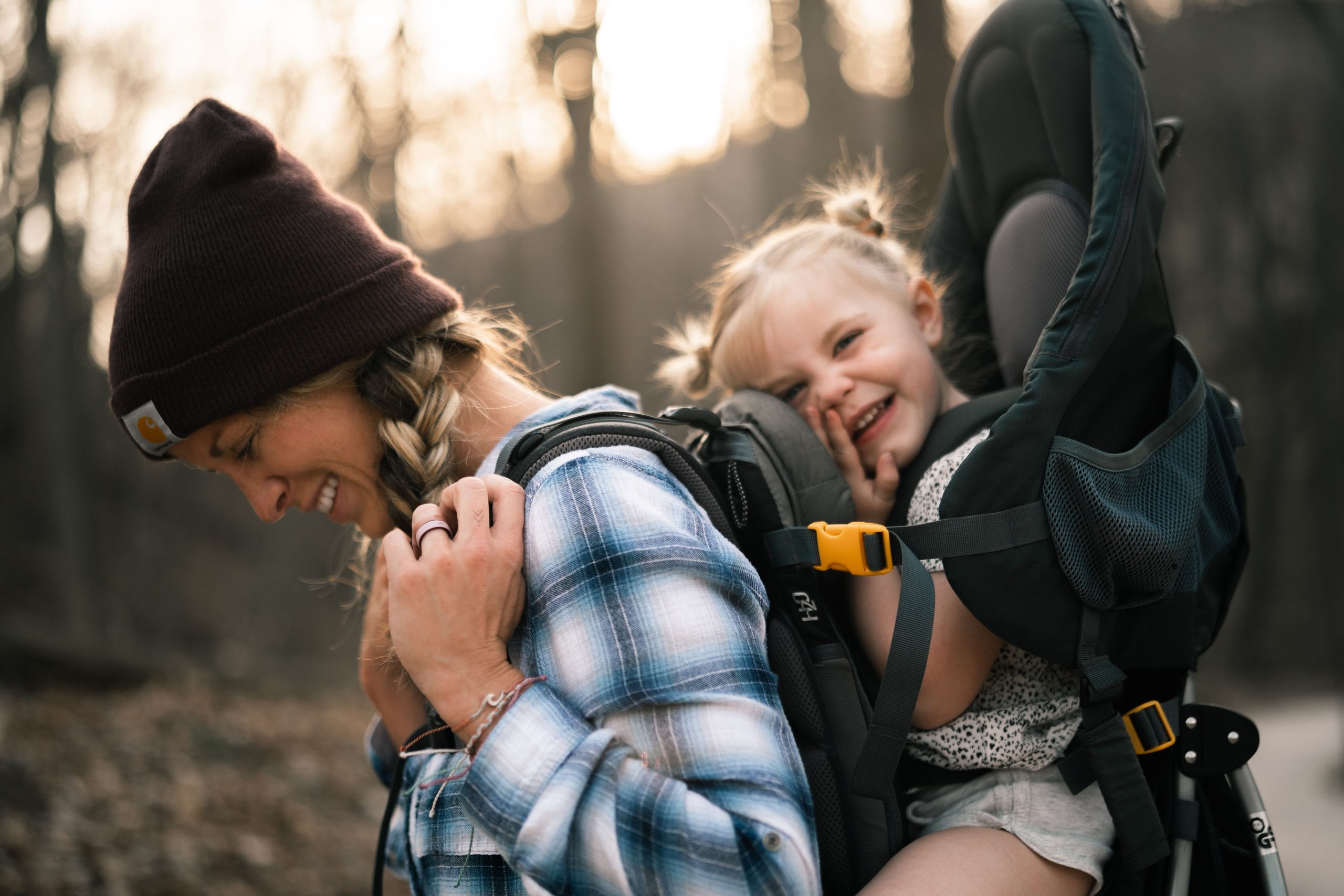
For the child, the carrier can become much more than transport. It can be their lookout tower, snack station, nap pod and refuge when the world feels big or little legs are tired.
They should sit securely and naturally rather than simply hang from the harness. Look for:
- an adjustable seat;
- effective side support;
- a comfortable chin or headrest;
- good sleeping support;
- appropriate leg support or footrests;
- useful ventilation;
- enough space to look around without being poorly supported.
Comfort is not a luxury extra. A child who feels secure and comfortable is more likely to enjoy being carried – and more likely to climb happily back in after walking for a while.
Where practical, take the child to the fitting. Let them sit in the carrier while it is correctly supported. Adjust it properly. Watch how they naturally position themselves.
Can they look around comfortably? Can they rest? Do their legs appear well supported? Do they seem content to spend time there?
The carrier is partly yours. But it is also going to become their place within the adventure. We’re firm believers in involving the child in the choice of the carrier – a carrier they feel a sense of ownership over, is a carrier they’ll be happier to go adventuring in.
Walking, riding and exploring
One of the most useful ways to think about a toddler carrier is not as something that replaces walking, but as something that makes more walking possible. The rhythm of a good family day might look like:
walk → explore → ride → snack → walk → investigate stream → ride → walk again.
That is very different from strapping a child in at the car park and carrying them for the entire day.
For an older toddler, side access can be particularly useful because it makes those transitions easier. With appropriate adult help, they can climb in and out without every change becoming a major operation.
Top-loading carriers can work perfectly well, but absolutely test getting them in and out a few times to ensure that the carrier you buy works not just when it’s on your back, but also during those many snack breaks you’ll be having.
The important question is how easily the carrier fits around the kind of day you want your child to have.
The carrier’s role is to make the child’s adventure as smooth as possible.
Load capacity: think beyond the child’s weight
The child’s weight is only part of what you will carry. Add:
- the carrier itself;
- water;
- food;
- spare clothes;
- nappies and wipes;
- first-aid items;
- weather protection;
- and everything else family life manages to generate.
A carrier that weighs two or three kilograms empty may feel dramatically different once everything is loaded. That is why the lightest carrier on paper is not automatically the easiest one to carry. A slightly heavier design with good suspension and effective load transfer may feel far better over several hours.
Check both the child’s permitted weight and the carrier’s overall load limits. And think ahead. The carrier should work not only for the child standing beside you today, but ideally for enough of the next stage of family life to justify buying it.
Storage: enough to create freedom, not enough to carry the kitchen sink
Storage matters. A spare layer lets you stay longer when the temperature drops. Food buys you another hour beside the waterfall. Dry clothes can turn an unexpected soaking into a funny story instead of the end of the day.
But litres alone do not tell you whether storage is useful. Look at where things go. A big lower compartment may hold spare clothing brilliantly, while accessible pockets for snacks, wipes and water can make everyday use much easier.
Think too about who is carrying everything. Generous storage may mean one adult can carry both child and family kit. That can be liberating. It can also mean one person ends up carrying far too much.
The objective is not to maximise capacity. It is to carry what allows the family to stay safe, comfortable and flexible without creating an unnecessarily heavy load.
Weather protection: compare what’s included
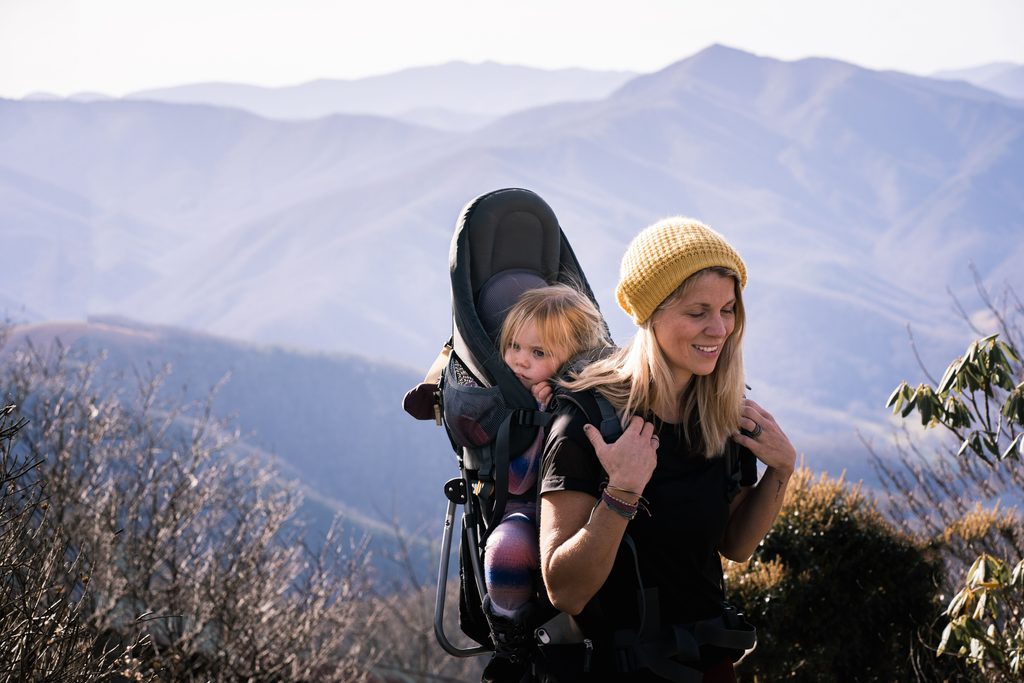
Sunshades and rain covers can make a child carrier much more versatile, but the setup varies considerably between models. Some carriers include a built-in or integrated sunshade. Others require you to buy one separately. Rain covers are often optional extras too, so factor them into the real price rather than comparing the carrier alone.
When choosing between models, look at:
- What comes as standard? A cheaper carrier can stop looking cheaper once you add the weather accessories you actually want.
- Is the sunshade built in or detachable? Integrated shades are convenient because they are always there when you need them.
- How much coverage does it provide? Some shades protect mainly from overhead sun; others offer more side protection.
- Does it still allow good airflow and visibility? More coverage is not automatically better if it makes the space enclosed or difficult for the child to see out.
- How easy is it to deploy? A shade or cover you can put up quickly without unloading the child is much more useful in changeable weather.
- Where does it store? Check whether accessories pack neatly into the carrier or need to be carried separately.
- How secure does it feel? Lightweight shades and covers should still stay stable when conditions become breezy.
Weather protection probably shouldn’t decide the carrier on its own, but it can make a meaningful difference between two otherwise similar models.
Compare the carrier as you’ll actually use it – including the accessories you’re likely to need.
Ventilation: comfort affects whether kit gets used
Ventilation matters for both adult and child. Mesh backs and airflow channels can be particularly welcome on warmer days, although some adults prefer a load that sits closer and feels more directly connected to the body.
There is no universally correct answer.
This is another reason to try a carrier rather than buying entirely from reviews. A cooler, more comfortable adult is more willing to carry. A more comfortable child is more willing to ride.
Those two things together determine whether the carrier actually earns its place in family life.
Adjustment: especially important if adults will swap
If two adults will share carrying, easy adjustment matters much more than it first appears. A carrier adjusted correctly for one adult may be uncomfortable — or unstable — on somebody with a very different build. Look for:
- a useful torso adjustment range;
- a hip belt that fits both adults;
- clearly marked settings;
- adjustments that can be changed without dismantling the carrier.
Swapping adults before somebody becomes exhausted is good family group management. A carrier that makes that easy gives you more options.
Family-life fit: will the carrier actually come with you?
Outdoor equipment does not live permanently on a mountain. It lives in houses, car boots, hall cupboards, trains, hotel rooms and holiday cottages.
So ask some deeply unglamorous questions. Does it fit in your car? Where will it live at home? Can you carry it through a station while also managing a child and luggage? Will it fit where you need it to go on holiday? Is it so awkward that getting it out for an hour-long woodland walk becomes more hassle than it is worth?
A brilliant hiking carrier that is always left in the garage unlocks nothing.
For some families, a bigger carrier with excellent suspension and storage is absolutely worth the bulk. For others, a smaller carrier that gets used three times as often is the much better adventure tool.
Cleaning, durability and repair
Family kit gets used. Properly. Expect mud, crumbs, dribble, wet boots, squashed bananas and the occasional incident best forgotten.
Removable pads and washable child-contact areas are genuinely useful. So is access to replacement buckles, straps, accessories and repair support.
Durability matters particularly if:
- you expect several years of use;
- you may use the carrier for more than one child;
- you want a strong second-hand resale value;
- or you simply prefer buying good equipment once and keeping it going.
The most sustainable carrier is often the one that survives long enough to stay in family life.
Safety and readiness
A child carrier can extend the range of adventures available to a family, but it also changes the way you move.
Always follow the manufacturer’s current instructions, particularly around:
- minimum developmental requirements;
- child and total load limits;
- harness adjustment;
- loading and unloading;
- use of the support stand;
- weather protection;
- care and inspection.
Before heading into the hills, practise somewhere forgiving. Learn how to put the carrier on and take it off safely. Walk with realistic weight. Get used to the additional height and the way a moving child affects balance.
Remember too that the child is not generating heat through exercise in the way the adult is. Check them regularly rather than assuming that because you feel warm or comfortable, they do too.
And let the terrain reflect the fact that you are carrying a child. Adventure should expand as capability grows. It does not need to begin with the hardest route available.
The American Academy of Pediatrics provides additional guidance on choosing and using child carriers safely, including framed backpack carriers.
The Adventure Baggers Six-Point Carrier Test
Once you have a shortlist, score each carrier from one to five against these six questions.
1. Adult Fit
Can the person who will mostly carry it, wear it securely and comfortably under realistic load? Can they cover long distances with it?
If the answer is no, stop there.
2. Child Comfort
Is the child secure, supported, able to look around and able to rest comfortably? Do they welcome being in it?
Again, this is essential and non-negotiable.
3. Adventure Fit
Does this carrier suit the walks, terrain and duration your family genuinely wants to do?
Not the ‘one day’ hypothetical expedition. Your actual family adventures.
4. Transition Fit
How easily can the child move between walking, exploring and being carried? Does the design support the kind of active participation you want?
5. Family-life Fit
Does it fit into your home and your life? Can you store it, transport it, adjust it, clean it and actually use it without unnecessary friction? Will it last as long as you need it?
6. Value
Will the features you are paying for unlock adventures you are genuinely likely to have? Take into account the cost of extras when determining best value.
Do not automatically buy whichever carrier achieves the biggest numerical total. Some criteria will matter much more to your family than others.
For one family, compactness may be the reason the carrier gets used every weekend. For another, all-day carrying comfort may be the feature that makes mountain adventures possible.
The score helps you think, but you’ll need to consider which criteria are non-negotiable for your family.
New, second-hand, or hire?
You do not necessarily need to buy a brand-new premium carrier.
Buying new
Buying new gives you current instructions, warranty support and confidence in the carrier’s history.
It can make particular sense when you expect frequent use over several years.
Buying second-hand
A good used carrier can make family adventure considerably more accessible. But inspect safety-critical parts carefully. Check:
- the exact model;
- manufacturer instructions;
- current recall information;
- frame condition;
- stitching;
- shoulder and hip straps;
- child harness;
- buckles;
- support stand;
- missing or damaged components.
Cosmetic wear is one thing. A damaged frame, buckle or harness is another – that becomes a safety issue. If the history or condition of a carrier leaves you uncomfortable, walk away.
Hiring first
Hiring can sometimes answer more than hours of online research.
Does your child actually like being carried? Can they nap in it? Does the hip belt stay where it should? Can you manage the combined weight comfortably? Does the thing even fit in the car?
Hiring can be especially valuable if the carrier is needed mainly for one holiday, if your child is already relatively large, or if you want to test a premium model before spending heavily.
Common mistakes when choosing a child carrier
A few traps are worth avoiding:
- Buying entirely from reviews or personal recommendations. Bodies, children and family adventures differ.
- Choosing the model with the most features. Every feature usually adds some combination of weight, cost or bulk.
- Ignoring accessory costs. Shades, rain covers and extra storage can change the real price considerably.
- Buying only for the child’s current size. Think about how long you hope to use the carrier.
- Assuming the lightest carrier will be easiest to carry. Loaded comfort matters more than empty weight.
- Buying the biggest carrier “just in case”. More capacity often means more weight and more temptation to overpack.
- Assuming one setting works for both adults. Proper adjustment matters.
- Forgetting how often the child will get in and out. The easier transitions are, the easier it is to let them explore.
- Ignoring transport and storage. The carrier must fit into the life that gets you to the trail.
The right carrier is a bridge
There is a lovely thing about child carriers. Their success eventually makes them unnecessary.
At first, the carrier may do almost all the work. Then a child begins walking the flat bits. Then the interesting bits. Then they want to climb every rock, investigate every stream and collect a pocketful of sticks while the empty carrier sits on your back waiting for tired legs.
Gradually, the balance changes. One day, you may carry the empty carrier for almost the entire route. Your child will take twice as long as expected, eat an improbable number of snacks and stop to examine things you would previously have walked straight past. Then they will reach the end and realise they did it themselves.
That is not the moment the carrier has become redundant. It is the moment it has quietly achieved what you bought it for.
The right carrier does not simply carry a child. It helps create the adventurer who will eventually walk beside you.
Choose the one that fits your family, your child and the adventures you want to share.
Let it become their safe place, their lookout and their refuge when little legs are tired.
Use it to reach places that would otherwise be out of range.
And make it easy for them to climb out whenever the world becomes too interesting to watch from above.
Because the best child carrier is not the one that looks most impressive in the garage. It is the one that becomes part of your family story.
Editorial note: Product guidance, specifications and safety requirements change. Always check the current manufacturer’s instructions, weight limits and recall information before purchasing or using a child carrier.